When you plan a new driveway or replace a worn-out one, drainage is no longer a detail you sort out at the end — it is frequently the first thing that decides what you are even allowed to build. Rain that once soaked quietly into a front lawn now has to go somewhere, and covering gardens with solid, sealed surfaces has pushed more water onto streets that were never designed to carry it. That shift is exactly why permeable paving and sustainable drainage have become the default starting point for a well-planned drive.
This guide sets out the rules in plain English, explains what actually happens beneath a permeable surface, and compares the three options most homeowners choose between — permeable block paving, resin-bound gravel and loose gravel — on cost, appearance and upkeep. Read it and you will be able to brief a contractor with confidence, or at least understand why a good one is steering you a particular way.
Why driveway drainage matters
A drive built on solid concrete, tarmac or mortar-bedded slabs sheds nearly all the rain that lands on it. That water has to escape somehow — typically over the pavement, into a road gully, or straight into a surface-water sewer that is already working hard. Multiply that by every sealed front garden on the street and the network simply runs out of headroom, at which point the overflow finds its way back onto drives, into gardens and occasionally through people's front doors.
Dealing with rainfall where it falls pays off in several practical ways:
- Lower flood risk on your street. Water eases into the ground steadily rather than arriving in the gutter all at once.
- Kinder to clay soils. Letting some rain stay in the ground helps stop shrinkable clay from drying out and cracking, which is what can eventually disturb walls and foundations.
- Cleaner water leaving your plot. The layered build-up traps silt and everyday pollutants such as oil drips before the water moves on.
- No puddles or ice. A properly built permeable surface drains through itself, so you are not left with standing water, winter ice patches or mud.
Planning permission and SuDS: the rules explained
This is where people most often come unstuck, so it is worth pinning down before you spend a penny.
The permitted development rule for driveways
In England you generally do not need planning permission to lay or replace a front-garden driveway if either of these applies:
- The finished surface is permeable (or porous) so rain passes through it into the ground — for example permeable block paving, gravel, or resin-bound gravel over a permeable base; or
- The surface is a traditional, non-permeable one, but the rainwater is directed to a permeable area inside your own boundary — a border, lawn or soakaway — instead of running out onto the road.
You typically do need planning permission only when you lay more than five square metres of non-permeable surface and let the water drain onto the highway. So the safe route is straightforward: choose a permeable surface, or keep the water on your own land, and you normally stay inside permitted development. These are national rules of thumb rather than a guarantee, so always confirm with your local planning authority — flats, listed buildings, conservation areas and some individual properties are treated differently.
What SuDS means
SuDS stands for Sustainable Drainage Systems, and it is the thinking behind everything above. Rather than rushing rainwater away through pipes, the aim is to slow it, hold it for a while, then let it soak in or release gradually. A permeable driveway is one of the neatest domestic examples: a single build-up that gives you somewhere to park, somewhere to store water and a bit of natural filtering, all in the same footprint.
How permeable paving actually works
What you see on top is only a fraction of the job. The permeability lives in the layers underneath, and that construction is genuinely different from an ordinary driveway.
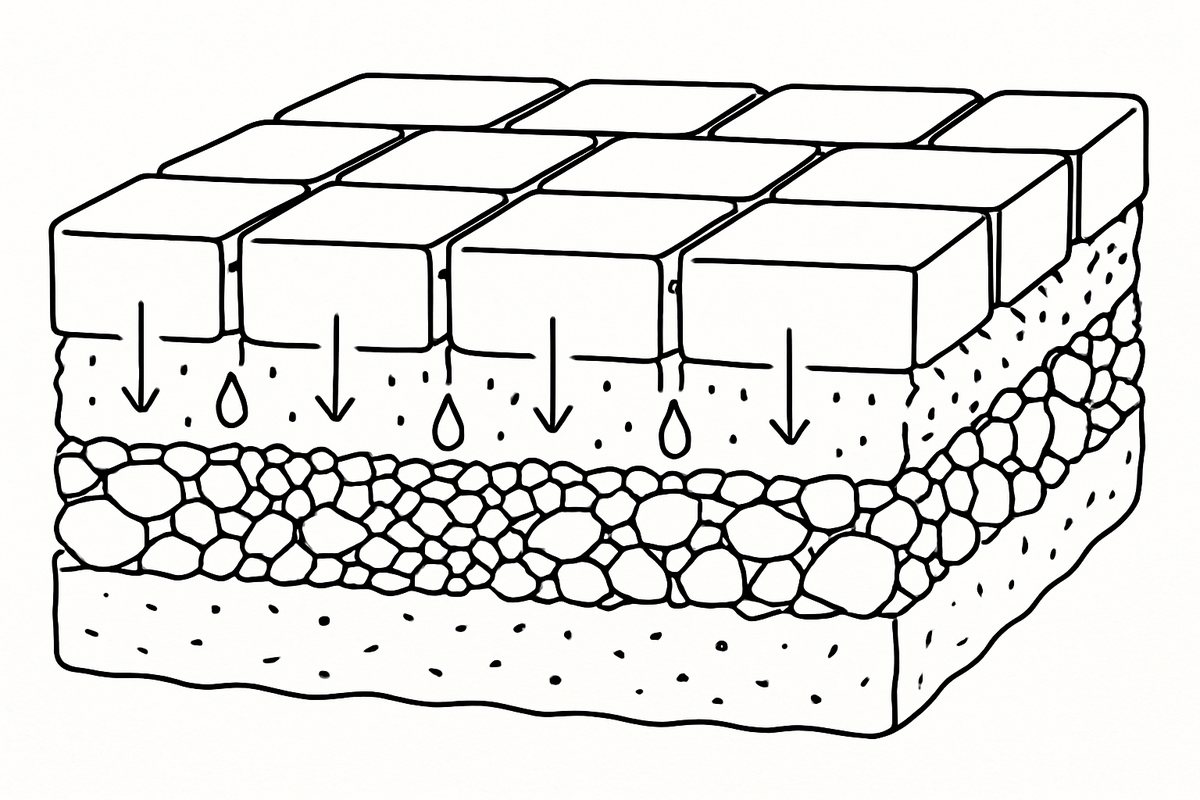
Reading a typical permeable block paving build-up from the top down, you have:
- Free-draining jointing grit in the gaps between the blocks, so water slips straight through instead of being sealed out.
- A laying course of clean, angular grit that beds the blocks while still letting water pass.
- An open-graded sub-base of clean crushed stone. Because it is single-sized angular rock rather than a compacted mix, it is riddled with gaps, and that space lets the layer double as a buried tank — briefly holding rainfall before it drains onward.
- A geotextile membrane between the layers, stopping the soil below from working its way up and silting the stone.
- The subgrade — the natural ground the stored water eventually seeps into.
Where the ground itself drains poorly — and stretches of Cambridgeshire and East Anglia sit on heavy clay — that same stone layer can instead be sized to hold water and let it out slowly through a perforated pipe to a suitable outfall, rather than depending on the soil to swallow it. Before choosing an approach, a competent installer digs a test hole, fills it and times how quickly it empties, so the design matches your actual plot rather than a guess. This is precisely the sort of judgement that justifies paying a professional.
Your main permeable options compared
Three surfaces cover the overwhelming majority of domestic permeable drives, and each brings its own look, price and upkeep.
Permeable block paving
These are purpose-made concrete blocks with slightly wider, spacer-formed joints that get filled with grit, so water drains between them. To the eye it is barely distinguishable from ordinary block paving, and it comes in a broad range of colours, textures and laying patterns to suit period and modern homes alike.
- Pros: handsome and familiar, hard-wearing, and individual blocks lift out and relay so you can reach buried services; no planning headaches when it is built correctly.
- Cons: the joints do collect debris and windblown seed over time, so an occasional clean and re-gritting keeps them draining. Laying it well is a skilled job — the sub-base is where success or failure is decided.
- Rough guide cost: commonly in the region of £90–£160 per m² supplied and fitted, depending on the block, the groundworks and site access.
Our fuller guide to block paving driveways goes deeper on patterns, edging and lifespan.
Resin-bound gravel
Here natural aggregate is blended with a clear resin and trowelled over a permeable base to leave a smooth, seamless surface. True resin-bound gravel — not the cheaper, sealed resin-bonded version it is easily confused with — is porous and free-draining.
- Pros: a smooth, modern, low-maintenance finish with no loose stones underfoot; a wide palette of colours; and an even surface that is easy to walk, push a buggy or wheel a bin across.
- Cons: it is only as good as the permeable base beneath it, so the groundwork is everything; the colour can shift slightly under years of sun; and a repair is harder to hide than swapping a single block.
- Rough guide cost: commonly around £100–£180 per m² installed, with the base preparation being the main driver.
Loose gravel
The oldest and cheapest permeable choice. Laid over a proper sub-base and, ideally, a gravel-stabilising grid, it drains readily and looks right in front of cottages and rural homes.
- Pros: low cost, permeable by nature, simple to top up, and the crunch underfoot is a modest security bonus.
- Cons: without edging and a stabilising grid the stones wander and scatter; it is a poor choice on a slope; and it wants the odd rake and refill.
- Rough guide cost: commonly around £40–£90 per m² installed with a stabilising grid, and less again for a plain gravel bed.
Every figure shifts with site access, the amount of digging and spoil to cart away, the edging you choose, and whether an old surface has to come up first. Treat all of these as planning-stage guides, never as a quote.
A realistic word on maintenance
Permeable surfaces are not fit-and-forget. Because they rely on open joints or a porous matrix, they can slowly silt up if ignored, and the flow drops off as the gaps fill. The reassuring part is that keeping on top of it is easy:
- Sweep or blow the leaves and grit off regularly, autumn especially.
- Give block paving an occasional gentle wash and top the jointing grit back up — but resist emptying the joints with a full-power pressure washer.
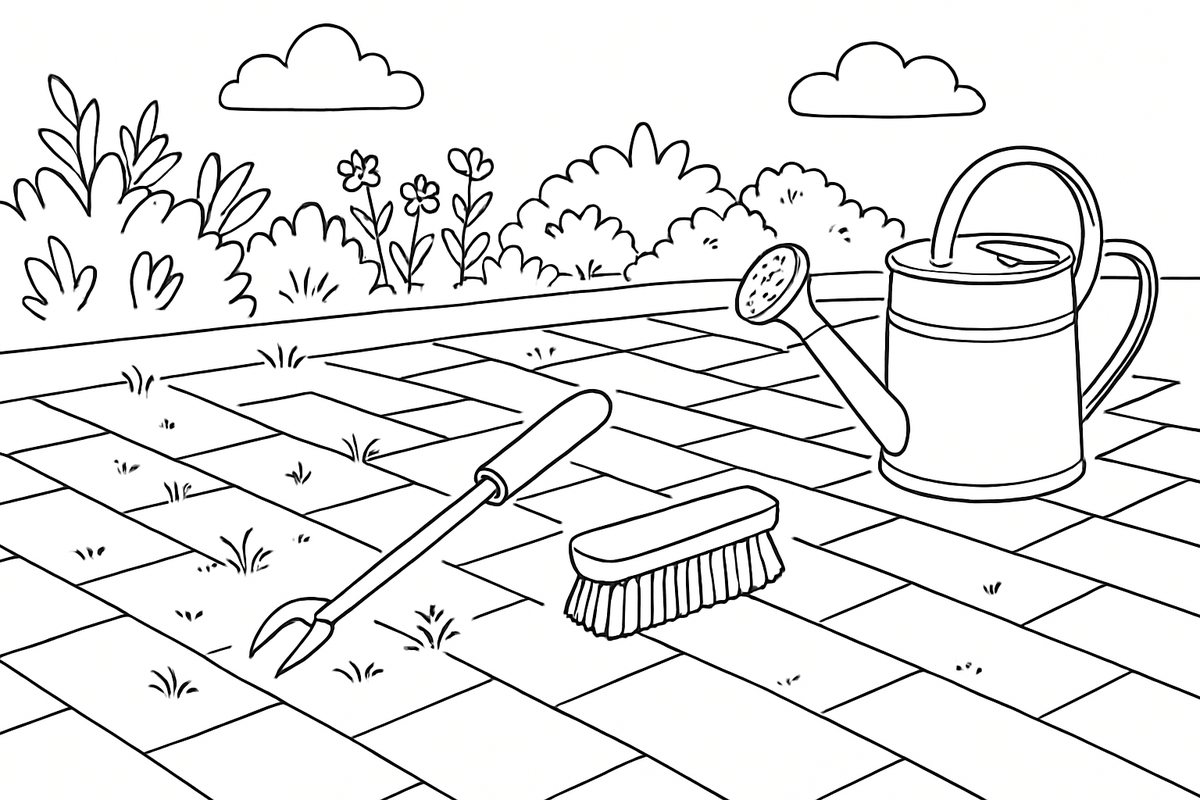
- Deal with moss and weeds before they take hold. Our advice on cleaning block paving and removing weeds and cleaning a patio works just as well on permeable surfaces.
Handled sensibly, a few minutes each season keeps a permeable drive draining freely and looking sharp for decades.
DIY or hire a professional?
From above, permeable paving looks like any other paving — but the value sits entirely in what you cannot see. The depth of the dig, the correct open-graded sub-base, the falls, the edge restraints and the right drainage strategy for your ground are what decide whether the drive lasts twenty years or fails after two wet winters. Get the sub-base wrong and the tidiest blockwork in the world will not rescue it.
A small gravel path is well within reach of a confident DIYer. A load-bearing permeable driveway that has to satisfy planning rules and shrug off a car park's worth of rain is a job for an experienced installer with the right compaction plant and a working knowledge of the standards. If you are in any doubt, have at least the design and groundwork done professionally.
Get expert help with your driveway
At 1st Builders Cambridge we design and lay permeable driveways, patios and paths across Cambridge and East Anglia, matching the drainage approach to your ground conditions and keeping you the right side of the planning rules. You can see everything we offer on our decking, patio and paving services page.
For honest advice on the best permeable option for your home, get a free, no-obligation quote or call the team on 01223 912222. We are always glad to talk the options through before you commit to anything.
Frequently asked questions
Do I need planning permission for a permeable driveway?
In England you usually do not need planning permission for a front-garden driveway if the surface is permeable (such as permeable block paving, gravel or resin-bound gravel), or if a non-permeable surface drains its rainwater to a permeable area within your own boundary. Planning permission is normally needed only when you lay more than five square metres of non-permeable surface that drains onto the highway. Rules differ for flats, listed buildings and conservation areas, so always confirm with your local planning authority.
What is the difference between permeable and non-permeable paving?
Permeable paving lets rainwater pass through the surface into a free-draining sub-base below, where it is stored briefly and soaks into the ground gradually. Non-permeable paving, such as solid concrete, tarmac or mortar-bedded slabs, sheds water off the top, which then has to be collected and sent somewhere else. Permeable systems are the foundation of Sustainable Drainage Systems (SuDS).
Which is better: permeable block paving or resin-bound gravel?
Both are excellent, and the right pick comes down to the look you want and your budget. Permeable block paving gives a traditional appearance, a huge choice of colours and patterns, and blocks that lift out for repairs or to reach services. Resin-bound gravel gives a smooth, seamless, low-maintenance modern finish. Both depend on a properly built permeable sub-base, so how well it is installed matters more than the surface you see.
How much does a permeable driveway cost in the UK?
As a rough planning guide, permeable block paving commonly costs around £90–£160 per m² installed, resin-bound gravel around £100–£180 per m², and stabilised loose gravel around £40–£90 per m². The real figure depends on site access, how much excavation and spoil removal is involved, the edging, and whether an old surface has to come up first, so always get a site-specific quote.
Does permeable paving need much maintenance?
It needs a little regular care rather than none. Sweep off leaves and debris, stop moss and weeds establishing in the joints, and occasionally top up the jointing grit on block paving so it keeps draining. Avoid emptying the joints with a full-power pressure washer. A few minutes each season keeps a permeable surface working well for many years.